
Your Website Isn't Dead. It Got Promoted.
Jul 09, 2026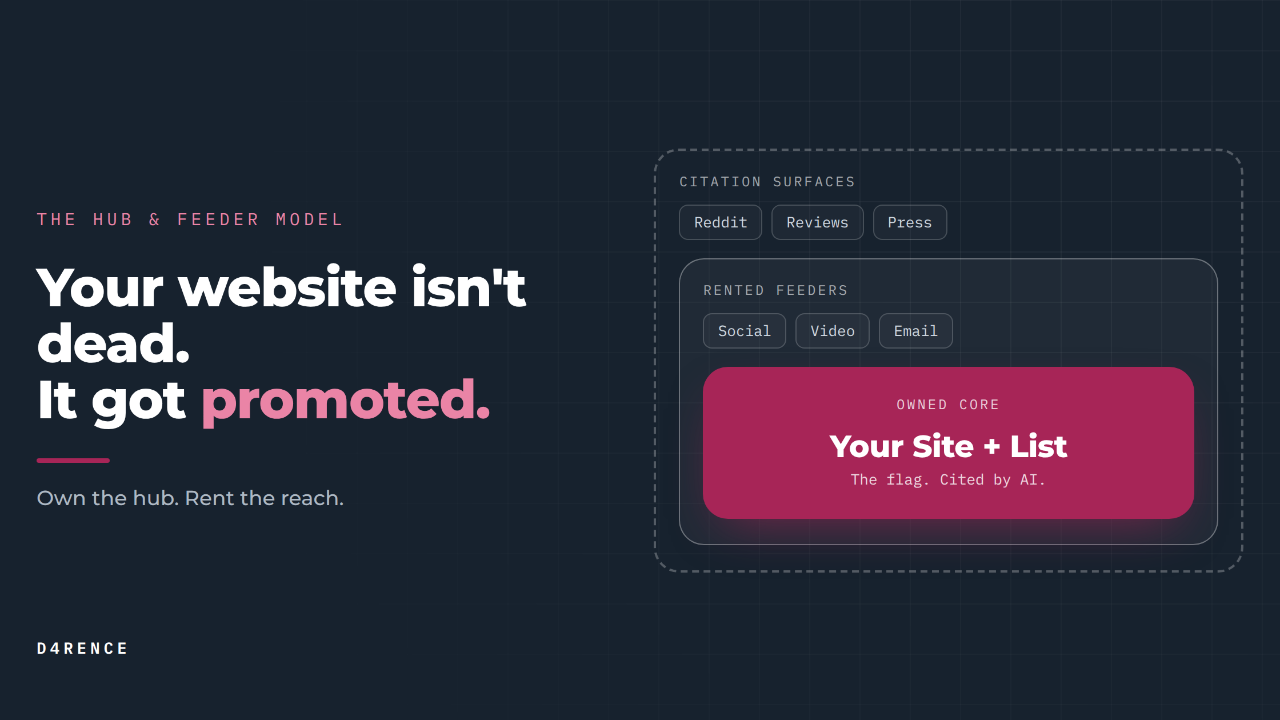
Open a browser, type a question, and the first thing you see now is not a list of links. It is an answer. The machine read the web, decided what was true, and handed it back to you before you clicked anything. So a lot of smart people have drawn the obvious conclusion: if the answer shows up before the website, the website must be finished.
It is a reasonable fear. It is also wrong.
That AI answer did not come from nowhere. It is the machine's best guess at the best response, assembled from sources it found and decided to trust. Something still has to be the source. The question was never whether websites survive. The question is what job they do now. And the honest answer is that the website did not die. It got promoted.
From destination to source
For twenty years, a website had one job: be the place people land. You ranked, they clicked, they browsed, they bought. Traffic was the whole scoreboard.
That job changed. Roughly half of Google searches now show an AI answer at the top, and when that answer appears, click-through on informational questions drops somewhere between 34 and 61 percent depending on whose study you read. If your scoreboard is still raw traffic, that looks like a catastrophe.
But look at what did not change. Brands that get cited inside the AI answer earn more clicks, not fewer, roughly a third more organic clicks than the brands the answer ignores. Transactional and buying-intent searches are far less likely to be summarized away, because that is where the money is. So the top of the funnel, the how-to and what-is questions, got absorbed by the machine. The bottom of the funnel, the moment someone is ready to hire you or buy from you, still runs straight through your own property.
The website's job moved from the place people browse to the source the machine trusts, and the place people land when they are ready to act. That is a promotion. It is also a harder job, because now you have two audiences: the human reading, and the model deciding whether you are worth quoting.
The game stopped being rank and became get cited.
The bigger problem nobody is naming
Honestly, the website question is not even the real issue. The problem I run into far more often is bigger, and quieter.
Most businesses do not know the difference between publishing content and running a campaign. They have posts going out, ads running, maybe a newsletter, and none of it is built to work together. Add AI and search into that mix and you do not get a presence. You get fragmentation. A pile of disconnected signals that never compound, and never tell the machine or the human a coherent story about who you are.
That is what a hub actually solves. Not the website specifically. The website is just the clearest example of something you own.
The mistake underneath the panic
Here is the real error hiding inside "websites are dead." It confuses a traffic destination with an owned asset.
Yes, the way people arrive is changing. That does not make ownership obsolete. It makes ownership the entire point. Every platform you build on that you do not own, a social feed, a newsletter tool, a community forum, is rented land. Different landlords, same lease. The algorithm can change, the terms can change, the account can vanish, and there is nothing you can do about it, because it was never yours.
You cannot plant a flag on rented land. So the strategic question is not "website or Substack or Reddit." It is "what do I actually own, and can a machine cite it?"
The architecture: three layers, one flag
Stop thinking in platforms and start thinking in layers of ownership.
The owned core is your hub. Your domain and your email list, treated as one asset. This is where citations resolve, where conversion happens, and the only layer nobody can take from you. This is the flag.
The rented feeders sit around it. Short-form content, social presence, video, a Substack, a LinkedIn presence, whatever your specific audience actually uses. Every feeder now has two jobs: guide humans toward the hub, and feed the machine evidence that you are the authority worth citing. Same content, two audiences.
The citation surfaces sit furthest out. The third-party places the AI treats as consensus, like Reddit and the review platforms in your industry. You participate there and stay genuinely useful. You never build your home base there, because it is the most manipulated and least-owned ground on the internet.
Everything on the outside exists to feed the core. For the reader, and for the model.
Why a site makes such a good hub
I keep pointing clients back to their own site, and it is not nostalgia. A site has no real estate limitation. You can publish as much as you want, structure it how you want, and nobody can throttle it or take it down. You cannot say that about anything you rent.
The catch is that owning it is not the finish line. You have to make it legible to both search engines and language models. Skip that step and you end up with a site nobody finds and a brand no machine can confidently identify. Knowing how to build for both is what separates a site that gets cited from one that quietly disappears.
The principle that makes it simple
Once you see the layers, the whole strategy collapses into one line: mediums are chosen by your audience, and the hub is chosen by ownership.
For the human side, the hub genuinely can live anywhere. Meet people on the medium they already use and route them in. That part is audience-first, and it is exactly right. But for the machine side, and for durability, the hub is not a free choice. It has to be something you own and something AI can cite. That single distinction answers almost every tactical question that follows.
Build the hub, then feed it with intent
Build your hub and own it. Then find where your target audience actually lives, not where you are most comfortable posting, and use those platforms as the spokes that feed the engine.
And when you get there, resist the urge to sell. Trust takes repeated, meaningful touches, the Rule of Seven, and not one of them should be a pitch. Give, and then give again. Publish content that educates, informs, and entertains. Do that consistently and you win the branding long game, which is the only one that compounds, and you build real authority with the people you are trying to reach.
The new scoreboard
If raw traffic is a broken gauge, replace it. Measure how often you show up in AI answers for the questions that matter. Measure the growth of your owned email list, the audience nobody can rent back from you. Measure conversions, the consults and demos and sales the hub exists to produce. Those numbers still map to revenue. Clicks alone no longer do.
The businesses that panic are the ones still counting the old thing. The businesses that win are the ones who understood the website never died. It just got a bigger job.
Frequently asked questions
Do I still need a website if AI answers the question first?
Yes. The AI answer is assembled from sources it trusts, so something still has to be that source. Your site becomes the thing the model cites and the place people land when they are ready to buy. It moved from a browsing destination to your owned, citable core.
What is the difference between publishing content and running a campaign?
Publishing content means pieces go out on a schedule. Running a campaign means every piece has a job and they all point somewhere. Most businesses are doing the first and calling it the second, which is why their posts, ads, and newsletters never compound into a presence. A campaign has a hub, spokes that feed it, and a plan for how a stranger becomes a prospect.
Should I publish my blog on my own site or on Substack?
Publish on your own site first, wait a day or two so search engines register it as the original, then post a remixed, shorter version to Substack with a link back. Publishing the identical piece in both places at once lets the bigger platform outrank your own site, and in AI search there is no "show more results" to fall back on.
Is Reddit worth it for my business?
As a citation surface, yes. Being genuinely useful in the right communities is one of the highest-impact things you can do, because the AI weighs that community consensus heavily. Just never build your home base there. You influence Reddit, you do not own it.
Get the Dispatch
Practical marketing and brand strategy for business owners who would rather build something that compounds than chase the next tactic. Written by Scott Sanchez.
Unsubscribe in one click. We don't sell your information.
